During my master’s program at Pacific University, Dr. Lisa Christiansen encouraged me to pursue an independent study on rural communities and behavioral health care. This came about because, having lived in rural communities in Pennsylvania and Oregon, I wanted to research what elements of rural culture are left out of the discussion or overlooked by clinicians.
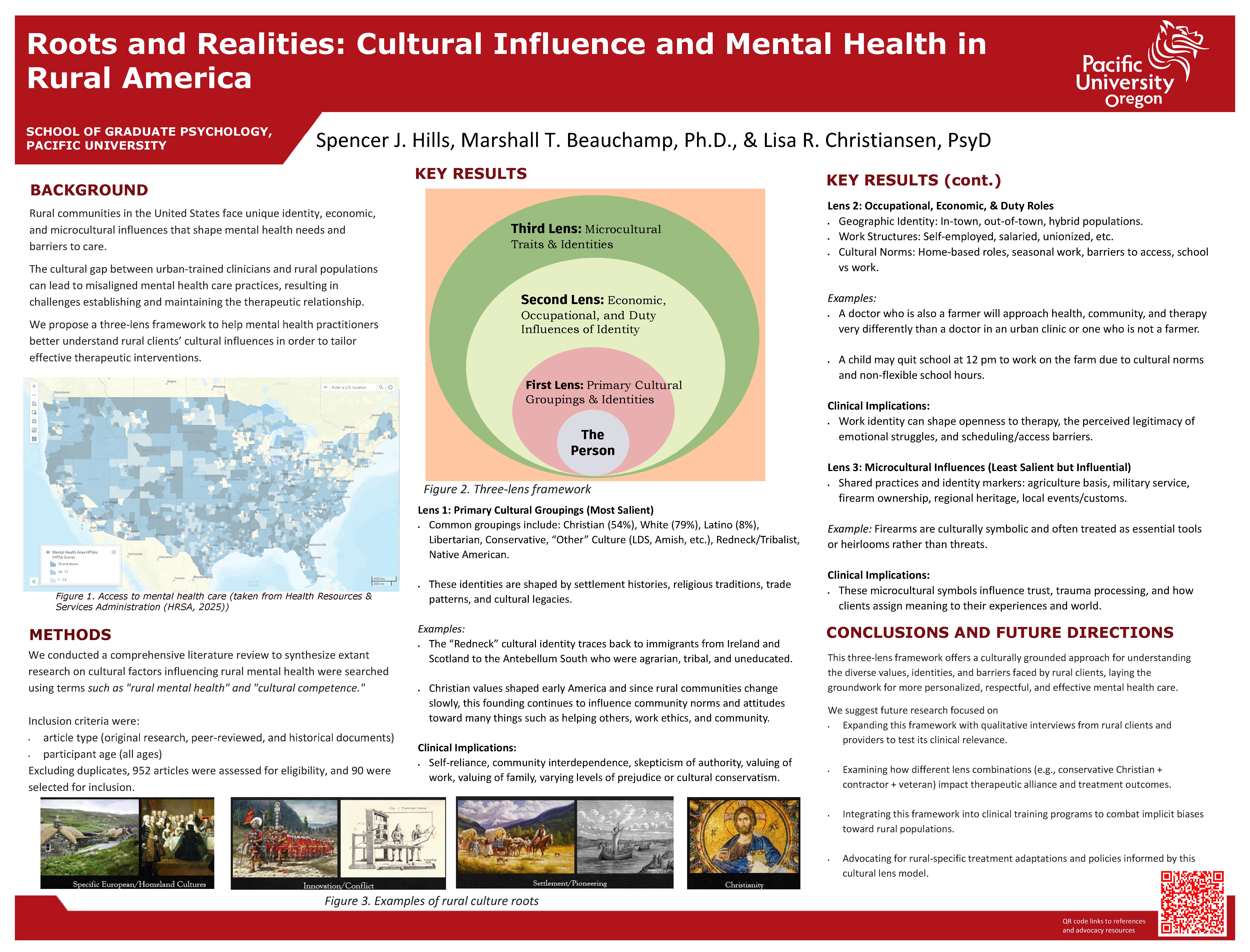
I reviewed the literature on rural mental health and developed teaching materials for a course. That work became Roots and Realities, a poster I presented at the 2025 Western Psychological Association convention. It introduced three lenses for understanding an individual's rural culture in a clinical setting, starting from the broadest lens and then getting more specific to the individual in the 3rd lens.
Click the poster to view it full size.
Three lenses for understanding rural culture
The three lenses move from the broad identities people use to introduce themselves to the routines and expectations that are specific to a person or family.
Lens 01
Primary identity
The first lens considers the broad groups a person identifies with. These may include racial, ethnic, religious, or political identities such as White, Latino, Native American, Christian, or conservative. People often name these affiliations first when describing who they are. They are also the kinds of categories used to describe populations in surveys and demographic research. In a clinical conversation, the question is which of these identities the person emphasizes and what belonging to those groups means to them.
Lens 02
Duty and work
The second lens examines how a person’s roles and responsibilities shape what they do. Occupation is part of that picture, alongside school, caregiving, and obligations to family, neighbors, or the community. Place matters, too. Living on a farm, working in town, or moving between the two can bring different routines and expectations. During harvest, for example, a person’s availability may depend on the weather, the work still to be done, and who else is counting on them.
Lens 03
Subtle norms
The third lens focuses on the most personal layer of culture. Some practices are particular to a family or a small circle of people. Others are so familiar to the people who live by them that they rarely come up in conversation. A family might show concern by bringing food or taking over chores, while leaving it to the person who is struggling to bring up how they feel. Those everyday habits help a clinician understand what support looks like in that household, who is trusted with private concerns, and how someone signals that they need help.